|
||||
|---|---|---|---|---|
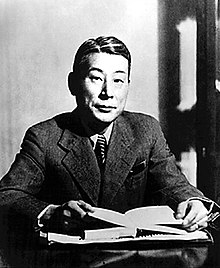
Chiune Sugihara Honoured by Yad Vashem Righteous among the Nations in 1984
Much has been written about Sugihara's life and work. We would like here to enlarge specifically on the Visas he issued with which many Jewish lives were saved.
|
||||
We bring here the research and article of Lucas Bruijn on the subject of The numbers Game in the Sugihara Curaçao VisasEscape from Lithuania. On the grounds of Temple Emeth, in Brookline, Massachusetts, a suburb of Boston, a monument was dedicated to One of the active members of Temple Emeth is Mr. Samuil Manski, himself a ‘sugihara survivor’. Yet another source has even wilder demographics: ”Visas for Life Foundation is
working to identify and document the stories of the 6,000 Sugihara survivors and their 100,000+ So, the numbers given by
Temple Emeth are modest, but even so, the less mathematically gifted will find it difficult to figure In order to get to 6 thousand saved people 3 people must have traveled on one visa: Two parents and one child, 4,000 grownups and 2,000 children. There is one slight mistake in the text: Sugihara arrived in Kaunas at the end of 1939 and
left that city on 4 September 1940. It is true though, that The exact number of visas issued by Sugihara, at least those he had made a list of, was 2140, the first issued on 9 July 1940, the last on 26 August. Issuing a transit visa is not the same as saving someone’s life. What counts is how many people made it to safety, that is, from Kaunas /Kovno to Vladivostok On September 12 1976 Mr. Jan Zwartendyk, the son of Jan Zwartendijk, to be introduced shortly, received a letter from rabbi Marvin Tokayer, for many Statistics
Total Refugees from Kovno -2178
Male Age 1-15 99 15-30 657 31-50 636 50+ 116 total 1508
Female Age 1-15 114 15-30 178 31-50 228 50+ 46 total 566
TOTAL 2074 (-104?)
Occupations MD 15 Engineer 62 Attorney 61 Clerk 233 Rabbis 79 Rabbinical Student 341 total 791
Emigration
USA 532 Canada 186 Australia 81 New Zealand 29 tot 828
Mexico 17 Cuba 27 Panama 2 Argentina 40 Brazil 17 tot 103
Burma 28 Manchuria 15 tot 43 TOT 1055 Shanghai 860 Other ? Total 1915 (-263) The Jewish community of Kobe made lists of the arrivals and reported to the American Jewish Joint Distribution Committee. These lists give name, The United States Holocaust Memorial Museum, which organised an exhibition on the subject in 2000/01, “Flight and Rescue”, with a catalogue (2001) Another source mentioning the number 2,000 is the ambassador of the United States in Moscow Laurence Steinhardt. He wrote a letter to the “…. The story is somewhat more complicated. Not all holders of a Japanese transit visas actually went to Japan. Some went to other cities in China, such as Type in ‘Sugihara’ on ‘Google’ and a world of special websites dedicated to him will appear. A large list of publications, articles and books in many It is not my intention to unravel these stories or to explain how they came about, but to clarify some points in the true story and to add some information History What should be obvious is the fact that a transit visa only allows a traveler to travel through a country or arrive in a country en route to a final destination. The distance from Kaunas to Vladivostok, by plane, is 7,206 Kilometers. By train it is 9,289 kilometers from Moscow. Nowadays it takes six days to travel The Germans invaded western Poland on 1 September 1939. The Soviets occupied eastern Poland on 17 September 1939, including the city of Vilnius and The Soviet Union was represented in Kaunas (Kovno) by a consul appointed by the People’s Commissariat for Foreign Affairs (NKID). This consul, Nikolai Visas were only issued to refugees, who had a final destination visa and the necessary transit visas and money to reach that destination. The most popular destinations were the United States and Palestine, but the visas issued by the Americans were few and the same with the Palestine Certificatesand Palestine visas issued by the British. A new destination was invented, not as a true destination, but for the purpose of acquiring a Japanese transit visa and a Soviet transit/exit visa. It was called the ‘Curaçao visa’, which stated that no visa was required for that island or for Surinam, Dutch Guiana, without stating that admittance could only be obtained through the local Governors and that these seldom granted a landing permit. The man who issued at least 2345 such visas, the first on July 22, the last on August 2, was the honorary consul Jan Zwartendijk, a businessman who had come to Kaunas as the director of Philips, manufacturer of radios and other electric equipment. All consulates and embassies but the Soviet consulate were shut down during the first week of September 1940. Sugihara left on September 3, around the same Although we don’t have numbers, some Jewish refugees left Lithuania for Palestine or the United states at the beginning of 1940, but the escape through the Alternatives A plan for an alternative route of escape was discussed by the Chief Rabbi of Palestine Chaim Herzog during his visit to London in February 1940 with the In a report to the People’s Commissar for Foreign affairs, Vjatsjeslav Molotov, dated 21 April 1940, which mentions the talks between Herzog and Maisky, “ I would propose that it would be possible to allow Intourist to take responsibility for organising the transit of Jews to Palestine through the USSR, instructing it to reach agreement with the People’s Commissariat for Internal Affairs (NKVD), the People’s Commissariat for Transport (NKPS), and the People’s Commissariat for Navy affairs. (NKMorflota), about the logistics of this whole matter. “ Zorah Warhaftig, at that time a refugee representative in Lithuania heading a committee for Polish-Jewish refugees, reports in his memoirs that the decision to grant transit visas was made public in Lithuania on April 22. From May 24 to August 10 the Soviet consul Yakovchik issued 259 transit visas. We have a list with the names of the recipients, but no travel documents with such visas. About 30 of the persons listed also applied for a Japanese transit visa and it is uncertain whether any of the people on the list actually went to Palestine through Odessa and Turkey with such a Soviet visa. Even if the Odessa scheme had worked, the British embassy issued very few visas for Palestine and it would not have been a solution for the many refugees who wanted to get out after the Soviet invasion of Lithuania on 15 June 1940. Some refugees of Dutch origin thought up a new idea. Shortly after the invasion, late June, Jan Zwartendijk, who had been appointed honorary consul in Kaunas on 14 June 1940 was approached by Mrs. Pessla Lewin, who before her marriage to a Pole, Isaac Lewin, had the Dutch nationality She asked him whether he could issue a visa for the Dutch West-Indies. The answer was negative. The main Dutch diplomatic representative in the Baltic countries was the Dutch ambassador L. P.J. de Decker in Riga, Latvia. Mrs. Lewin wrote to him asking the same question. He initially told her, that there was no such thing as a visa for the Dutch Caribbean possessions because a landing permit could only be issued by the local governors. She wrote to him again, asking him to make a note in her Polish passport that no visas were required for Curaçao and Surinam and this time De Decker agreed, asking her to send him her passport. In her passport he copied the first half of the entry in his diplomatic handbook re the Dutch East Indies, saying in French: “For the admission of aliens to Surinam, Curaçao and other Dutch possessions in the Americas, an entry visa is not required.”
This remark was dated July 11 1940. However, De Decker refused to do the same for her husband. So she went back to consul Zwartendijk, who agreed to copy the De Decker notice in Pessla’s passport on Isaac Lewin’s Lithuanian Sauf-Conduit document on July 22.
The next step for the Lewins was to obtain a transit visa for Japan, because the only route to the Dutch West-Indies was through Japan. On July 25th and 26th LEVIN, Leiba Polnisch 25 July No.13 LEVIN, Isak Polnisch 26 July No.17
Sugihara wrote above the visas, in Japanese characters, in English:
Transit Visa 26 VII 1940. Seen for the journey to Curaçao and Surinam through Japan.” The Lewins never intended to travel to the Dutch West-Indies, they just thought up a way of escape from Lithuania. The Lewin family also obtained another destination visa, for Palestine, issued to them by the British consulate on 18 August 1940. Eventually, on 11 December 1940, the Lewin family would receive a transit / exit visa for the Soviet Union for the journey to Palestine via Vladivostok. They had 15 days to make the journey and according to the Vladivostok exit stamp they left that city for Japan on 31 December 1940.
We meet them again on the list of arrivals for January 1941 made by the Jewish community in Kobe:
100. Lewin Izaak Age 30 Born in Wieliczka; Profession: Rabbi; Date of arrival 2.1.1941, coming from Vilno 101. Pessla Age 30 102. Natan Age 5. On the Kobe lists we also find two Dutch citizens under arrivals in December 1940: Gutwirth, Tenzer Nathan, Age 24 Coming from Telschei, date of arrival 24.12.1940 Gutwirth, Nechama, Age 23, Born in Vilno, Coming from Telschei, date of arrival 24.12.1940 On the Sugihara list: GUTWIRTH, Tenzer Nathan Neserlands 6 August 1264
Nathan Gutwirth, a student at the Telshe yeshiva (in Telšiai, Lithuania) is also connected with the ‘Curaçao visa’ story. Being Dutch he hoped to travel to Surinam or Curaçao in order to reach the United states from there. It is not clear from the accounts whether he thought up the Curaçao solution independently or had heard about it from the Lewins. Mid July he visited Zwartendijk and asked for a ‘Curaçao visa’ for himself and for some of his friends. Since there was a precedent, Zwartendijk agreed and eventually issued the statements about the West-Indies not needing a visa to all who asked for it. He numbered them and the visa with highest number recovered is No. 2,345, issued on August 2 to Eliasz Kupinski and family. The first 1300 he wrote out by hand, after that he used a stamp. He stopped after that date, because the Soviets had confiscated his house and offices.
The Japanese consul continued issuing visas until the end of August. According to his list the last visa was issued on 26 August, but some travel documents with his visas dated 29 August have been found.
Because the Sugihara visa stamps start with the text: Transit Visa, Seen for the journey through Japan (to Suranam, Curaçao and other Netherlands’ colonies.) one would think that the Curaçao visa scheme was a kind of Dutch-Japanese joint venture and that the two consuls had reached some understanding about helping
Why not to the Dutch East-Indies? The Dutch East-Indies, or the Dutch-Indies were invaded at the end of February 1942 by the Japanese and the Allied Forces surrendered on March 8. The combination of a Curaçao visa and a Japanese transit visa opened up a new possibility of escape, but during the period these visas were issued none of the recipients obtained a transit or transit/exit visa from the Soviet authorities and if they did receive a Yakovchik transit visa they did not make use of it or could not make use of it. The two consuls did not know that their visas would ever be used with success. Their visas offered some hope, but no guarantees. It should be mentioned that no one actually tried to go to Curaçao. Not one of the refugees showed op either in Curaçao or in Surinam. The numbers of visa issued by both consuls are not exactly the same: 2,140 Sugihara visas against 2,345 Zwartendijk visas, a difference of 205. Sugihara starts his list with visas issued on 9 July 1940, while the first visa to a holder of a Zwartendijk visa was his No. 13, issued on 25 July. He also issued transit visas to holders of different end visas, for the United States, Canada and Palestine. In those cases the line “to Suranam, Curaçao and other Netherlands’ colonies” is crossed out and replaced by the final destination. To mirror all Curaçao visas Sugihara’s list should have more visas instead of less. Some families, but not all, traveled on one family visa. For instance, Nechama Gutwirth is not on the list, only Nathan, but the Lewins have two separate visas. Whether one or more visas were issued depended on the travel document used. In case of passports, both parents have their own passport and small children are added to the passport of one of the parents, usually the mother’s. Most Polish refugees did not have passports and traveled either on a Lithuanian ‘Leidimas’ or Sauf-Conduit document or on a ‘Zaświadczene Certficat’, often referred to as a ‘Polish Certificat’, a document certifying that the holder was a Polish citizen. The latter were issued by the British Embassy, Chargé-d’Affairs for the Polish interests in Lithuania. These document were made out to complete families. These family visas could account for the difference in numbers, but it is also possible that some people who had received Curaçao visas never took the next step. The 2178 arrivals in Kobe mentioned by Tokayer include small children that traveled on the visas of their parents.
Alledgedly some sugihara visas were ‘fakes’. Mid-March 1941 a ship with 74 refugees was sent back from Tsuruga, because the had Sugihara visas, but no Curaçao visas. The Dutch deputy-consul-general N.A.J. De Voogd signed 74 Curaçao visas. with the same French text as used by Zwartendijk. Of these 74 persons only about halve are on the Sugihara list and the others must have traveled on forgeries. The Dutch National Archives also keep copies of 68 of Curaçao visas, made out for about 77 others, this time written in English, without any explanation why they were issued. These extra refugees don’t change the number of Kobe arrivals.
It appears that Sugihara wrote out some visas after taking up his post as consul in Czechoslvakia, early 1941:
“John G. Stoessinger, Ph.D. (Harvard), a prize winning author of ten leading books on world politics, has been the recipient of the distinguished Bancroft Prize for History for The Might of Nations, and has served as Acting Director for the Political Affairs Division at the United Nations. On the eve of World War II, Dr. Stoessinger fled from Nazi-occupied Austria to Czechoslovakia. His family was saved by a Japanese diplomat, Chiune Sugihara, who issued three visas to transit Russia, allowing them to escape to Shanghai via Siberia and Kobe. “
The Soviet Visas We have no precise information about when, why and by whom the decision was taken to issue Soviet transit / exit visas. In August 1940 there seems to have been an effort to revive the old Odessa plan. In an exchange by telegram between Ivan Maisky, the Soviet Ambassador in London, and the Chief rabbi of Palestine Herzog of August 28 1940 Maisky reported that the Soviet government had agreed that persons in Lithuania holding valid end-visas could be permitted to exit the Soviet Union.
Dekanozow, the People’s Commissar for Foreign Affairs, had arrived in Kaunas with the Soviet troops on 15 June and was in charge of the Sovietisation of the country. but he had left Lithuania in July, around the Lithuanian elections of July 16. The newly elected parliament would decide a few days later that Lithuania wanted to be incorporated in the Soviet Union, a wish granted on 3 August 1940. The further integration of Lithuania into the Soviet Union was trusted to Nikolai Pozdniakov after Dekanozow’s departure. Although after the integration of Lithuania into the Soviet Union there was no need for a consul of the Soviet Union in Lithuania any longer, consul Yakovchik would remain in office for two months. He had temporarily stopped issuing transit visas on August 10 1940.
The little evidence we have for the visa history after the incorporation comes from the about twenty travel documents we have collected, that have a Soviet transit / exit visa. There are many more travel documents known containing Curaçao and Sugihara visas, but not all have a Soviet visa. We have two examples of Soviet visas that were stamped on loose sheets, to be attached to the main travel document and most likely most of these loose documents got lost over the years. From the stamps in this collection it appears that consul Yakovchik resumed the issuance of visas on 4 September 1940, After Sugihara and Zwartendijk had left and all other embassies and consulates had closed down. The last visa in the collection signed by him has as date 21 September. By then he had issued 302 visas, going by the lowest and highest numbers on these visas. There is a gap in the collection between his last and the next visa, which was issued on 23 October. Possibly he kept working until 3 October, while his successor started on 4 October. In that case the total number of Soviet visas would increase by a few hundreds.
Yakovchik, a Foreign Affairs official (NKID), was replaced by an Internal Affairs person (NKVD), and a Visa and Registration person (OVIR), who both signed the visas. The signature of the NKVD man on the visas changes frequently, the signature of the OVIR man only twice. The name of the OVIR man following up Yakovchik is not known, we failed to decipher his signature. The next one is known to us by his family name, Orechov, but we have no further information about the man.
From 23 October 1940 to 20 December 1940 609 visas were issued, about the same monthly amount as under Yakovchik. In January 1941 a huge amount of visas was co-signed by Orechov. From January 10 to February 11 1941 he issued 1973 visas.
All three worked with visa numbers belonging to a different series, so the visa numberes of the tree men are not consecutive. From the visanumbers we have it can be concluded that the total of Soviet visas issued was at least 2,885 visas, but the total number may well have been above the 3,000. The soviet visas were numbered, but one visa could have more than one number, for instance two parents and one older child would give three consecutive numbers. The names and age of smaller children would be entered, but they did not get a separate visa number.
Other destinations.
There is evidence that apart from the 2,000 refugees that reached Japan another group made it to Palestine through Turkey after all, but the information is confusing and numbers given vary: from 300 to 1,100 or 1,200 and even 3,000. The numbers 1,100 and 1,200 are taken from correspondence of the head of the Jewish Agency office in Istanbul, Chaim (Charles) Barlas. There are several individual stories about the trip. Here a selection of items found on the internet: The Menn family: The Soviet army occupied eastern Poland as part of the German-Soviet Pact and arrived in Molodeczno the same day as the Menn family. A young Soviet officer approached the Menn family and offered Bella a chocolate, asking David, who fought for the Russian forces in WWI, if they were Jews. Taking a risk David spoke to him in Russian and confirmed that they were. The officer said he, too, was Jewish and helped the Menn family get on a train to Vilnius. The family lived in the Vilnius ghetto for a year during which time Julius was able to attend a Lithuanian-speaking Tarbut school. In the fall of 1940 David managed to get four of a total three hundred transit visas that had been issued by the Soviet Union. The Menn family traveled by train through Kiev and Moscow to Odessa. From Odessa by ship to Turkey, then from Istanbul by train through Syria, Lebanon, and back to Palestine. They arrived in Tel Aviv in October 1940. [extracted from https://www.ushmm.org/remembrance/survivoraffairs/meet/detail.php?content=menn-j]
Yaakov Banai Tunkel As a youth, Banai was a member of Betar, the Revisionist Zionist youth movement and was a founding member of the Irgun in Poland and leader [Extracted from https://en.wikipedia.org/wiki/Yaakov_Banai ]
Mennas D. G. Mennas R. Kh. Yaakov Banai:
On Sugihara list: TUNKIEL, Jakow
Rabbi Shach Escaped to Eretz Yisroel Rabbi [Zalman] Sorotzkin: Rabbi Sorotzkin managed to flee the war and escape to Mandatrory Palestine. When the Moetzes Gedolei HaTorah (Council of Torah Sages) of the Agudath Israel was founded in Israel, Rabbi Sorotzkin was appointed vice chairman.
Rabbi Sorotzkin died in Israel on June 27, 1966 (9 Tammuz). Rabbi Sorotzkin authored the works, Oznaim LaTorah, a commentary on the Torah, and Moznaim LaTorah, on the Jewish festivals. He was survived by his five sons, Rabbi Elchonon Sorotzkin, author of Leman Achai VeRai and leader of the Chinuch Atzmai; Rabbi Baruch Sorotzkin,
On Sugihara List: SOROCZKIN, Bencjon SOROCZKIN, Boruch SOROCZKIN, Izrael SOROCZKIN, Lejzer
Hisya Reuveni-Shapira: Hisya Reuveni-Shapira (“Elinoar”), the daughter of Nette and Pesiah Shapira, was born in a small town in Poland on March 20, 1922. She attended the Tarbut [Extracted from https://jwa.org/encyclopedia/article/lehi-lohamei-herut-yisrael ]
A small group of British nationals, foreign students at yeshivas, travelled to Vladivostok and went from there to Hong Kong. From Hong Kong they went to
During the early years of World War II, Rabbi Elya Meir Bloch and Rabbi Chaim Mordechai Katz were in the United States on a fund |
||||
 Back to Current Searches Back to Current Searches |